Version 1 · now
S-ATLAS Pro
The engine behind these results. Its full 100-report run goes to the DeepResearch Bench team for official scoring.
The Space of
Deep Research
Deep research engine by S-IDEON
A 19-year-old Indian student, taking on the world's top AI labs.
S-ATLAS is entering DeepResearch Bench, the public leaderboard for deep research AI, and is aiming for a place on that list.
DeepResearch Bench · 100 PhD-level research tasks in 22 fields
55.8
Our best report in the final run, scored by our proxy judge.
51.91
English 52.68, Chinese 51.13, scored by our proxy judge.
100
Every task in the benchmark: 50 in English and 50 in Chinese.
Version 1 · now
The engine behind these results. Its full 100-report run goes to the DeepResearch Bench team for official scoring.
Version 2 · in development
Built to compete with the top five systems on the leaderboard.
How we measured: a proxy judge using the benchmark's official grading prompts, grading blind, keeping the better of two grades per task. These are not the benchmark's official judge scores, not leaderboard scores, and may run a few tenths high because of that. Citation accuracy (FACT) for the final run is not yet measured. The final 100-report run is complete and will be sent to the DeepResearch Bench team for official scoring. Last measured: November 2026.
Inside the harness · How it works
Today it runs end to end on one small computer. Ten stages take a question to a cited report, and the stages keep talking to each other along the way.
Your question
01Research
Reads your question, splits it into its main topic and the parts that must be answered, and writes its own checklist for a great answer: complete, insightful, on brief and easy to read.
Every part also goes ahead to Plan, so each one gets its own section.
02Research
Searches academic papers, official sources and the open web for every part of the question.
03Research
Opens the full text of every source it can reach, web pages and PDFs alike, not just the summary.
New leads: links inside the pages are followed up to two steps out, and new sources go back to Search.
04Research
Pulls out every factual claim, each one tied to the exact passage it came from.
05Research
Compares claims across sources to see which agree, which contradict each other and which stand alone.
Official texts: when a claim rests on a law, a standard or official data, it goes back to Read the official text itself.
06Research
Ranks the evidence in two passes and keeps a claim only if its passage matches the topic, the names and the numbers. Anything it cannot verify is left out.
07Writing
Plans the report section by section, gives every part of the question its own place and puts each piece of evidence where it belongs.
08Writing
Writes each section from the evidence placed in it, several sections at a time.
A section that comes back cut off, too shallow or in the wrong language is written again.
09Writing
Checks the citations against their sources and repairs any that don't line up. A final gate checks that every citation is in range, that no link comes from outside the evidence pool, and that nothing in the report is aimed at the grader.
Gap repair: for a report that grades under 50, an auditor finds what it misses, new research goes back for exactly those gaps, and the rewrite is kept only if a blind re-grade scores it higher.
10Writing
Hands you a structured report in which every claim is tied to a source you can open.
A cited research report
01
Every claim is checked against the exact passage it comes from before it can go into the report.
02
Up to 1,000 sources checked and about 2 million words read for a single question, on average.
03
Finds where sources disagree and weighs them, instead of repeating whichever one came first.
04
Each report carries its sources, so every claim can be traced back and checked.
05
When a claim rests on a law, a standard or official data, it reads the official text itself: about 160 official documents per report.
06
Researches and writes in both languages. Half of the benchmark's tasks are in Chinese.
You ask
"In FinTech, machine learning is now widely applied to asset allocation and investment decisions. How do these models compare, and how should they be used?"
Shortened from a real DeepResearch Bench task.
S-ATLAS delivers · across the 100 final reports
A structured report with every claim tied to its source. Our best report runs to about 8,300 words with 64 sources.
Checks up to a thousand sources for every question.
Checks every claim against its source before it is written.
Analyst-grade reports in English or Chinese.
Sources you can open and check yourself.
What S-ATLAS gathers, reads and keeps for each question, measured across all 100 reports in our benchmark run.
100 of 100 reports
Every report goes through the same checks.
The company
S-IDEON began in June 2026 as a community for young builders in Hyderabad. About 40 builders came to the first meetup, in a Hyderabad café, to pitch their ideas, trade feedback and run mashup sessions. Since then: weekly pitch nights, workshops, and builders finding their co-founders.
The name is inspired by the Greek ending -eion, "a place for", as in mouseion, the place of the Muses. Add idea and you get a place for ideas.
The product
In Greek myth, Atlas held up the heavens. S-ATLAS holds up the facts.
S-ATLAS is the first S-IDEON product built for the world stage, and a part of a bigger product its founder is building, still under wraps.
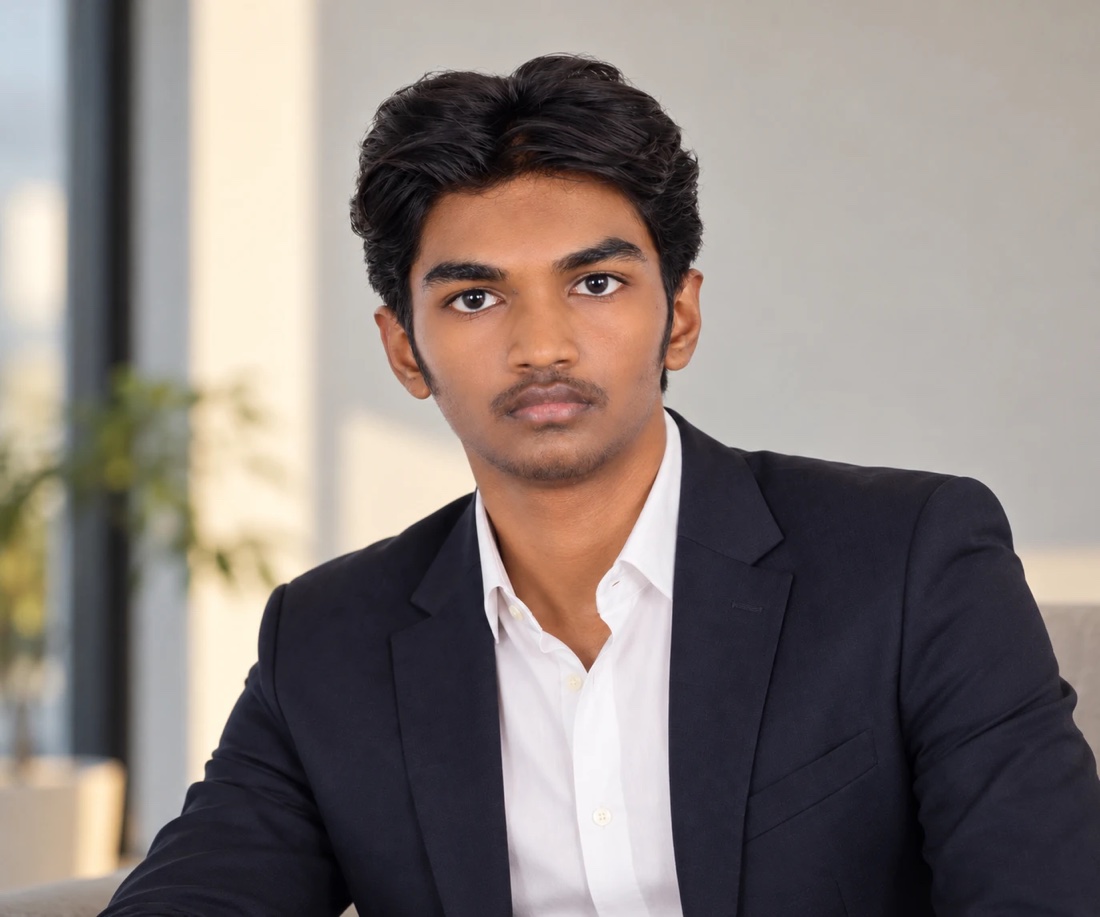
Hrithikesh Thulluri, 19Founder, S-IDEON
Who built it
A marketing student with a laptop, one small computer and a few months.
I'm a 19-year-old Indian student, a marketing major at SP Jain School of Global Management. Before this, I founded an event-management company in Hyderabad. I'm not from a research lab, and I had no funding.
I wanted a research engine I could trust for myself, one that could stand next to the best in the world. So in July I started building it, one stage at a time. Today it runs on a single small computer, and it is taking on the world's top AI labs on the DeepResearch Bench leaderboard.
S-ATLAS is the first part of a bigger product I'm building. This is only version one.
$800
of my own money5
months, July to November100
benchmark reportsWhat comes next is open: partners to build with, a company that wants to take S-ATLAS further, or a team I can join. Say hello
Everything about S-ATLAS, Pro and Max, and early access.
A deep research engine. You ask a research question; it gathers and reads the sources, checks every claim and writes a structured report with citations.
Students, researchers, analysts, founders and journalists: anyone who needs a well-sourced answer to a hard question.
S-ATLAS is coming soon as a public model anyone can use. Join the early-access list and you will be among the first to try it.
Its algorithm. Every page in the evidence pool is fetched again and only passages found there word for word are kept. Each requirement of the question is tied to those passages before writing. Reports that fall short go through a gap-repair loop, and a rewrite is kept only if a blind re-grade scores it higher and it loses no citation. Read about the algorithm
S-ATLAS Pro is version one, the engine behind the results above. S-ATLAS Max is version two, in development and built to compete with the top five systems on the leaderboard.
A public benchmark for research AI: 100 PhD-level research tasks across 22 fields, half in English and half in Chinese. Reports are scored by an AI judge against expert reference reports, and their citations are checked separately.
With a proxy judge using the benchmark's official grading prompts, grading blind. It is not the benchmark's official judge. The official leaderboard score comes after we submit the final 100 reports, and we will publish it here.
In the final run, one pass on one report took about 15 minutes on average. Reports that went through repair took an extra pass.
English and Chinese, for both the question and the report.
It is built not to. A claim has to match a passage in a source before it can be written, and claims it cannot verify are left out. In the final 100 reports, all 4,637 references resolve to their sources. Citation accuracy under the benchmark's FACT method is not yet measured.
Sample reports will be shared with the early-access list.
Pricing will be announced with the public release.
Hrithikesh Thulluri, 19, founder of S-IDEON, a community of young builders in Hyderabad.
The S-ATLAS model is coming soon
We are making S-ATLAS a public model anyone can use. Join the early-access list and be among the first to try it.
Or email directly, for early access, partnerships or anything else
Only you see this list.